I wasn’t aware of Tibet’s rich bread-baking history until Jolma Ren, owner of Amza Superfoods and writer of Beyond Her Kitchen, pointed it out in a comment here on my blog.
I first tried Tibetan food while living in Queens, a New York City borough recognized as the most ethnically diverse urban area in the entire world.
Colleagues at the New York Tibetan Service Center, where I taught after school classes for elementary school students, introduced me to momos, tsampa cake, and thukpa, a hearty winter stew.
Jolma suggested I try bread from Tibet’s northeastern region, Amdo, where she grew up.
Amdo bread is known for its unique baking method: round or oval loaves are buried in hot, crushed clay, where they are left to cook for around 15 minutes. Packed with smoldering earth on all sides, the loaves develop a thick, golden crust.

Jolma describes the process in detail here, recalling how her aunt prepared bread for Losar, the Lunar New Year, using this ancient method. She writes that Amdo bread is traditionally leavened with hundred-year-old sourdough starter, from an era before commercial yeast.
I found a recipe adapted to oven-baking (which, according to Jolma’s blog, is how most people in Tibet prepare bread these days with the exception of special occasions like Losar) from the website Simply Tibetan, and made a few modifications based on what was available in my pantry.
In place of fenugreek leaves, which the original recipe calls for, I sprinkled on cumin seeds and added a splash of maple syrup to the dough; the flavor of fenugreek is said to be reminiscent of maple syrup.
Ingredients
- 1 ¼ cups warm water
- ¼ cup milk (I used whole cow’s milk at room temperature)
- ½ teaspoon active dry yeast
- ½ teaspoon sugar
- 1 teaspoon table or fine sea salt
- 4-5 cups all-purpose or bread flour
- ½ teaspoon shoptsa (fenugreek leaves) or cumin seeds
- ½ teaspoon maple syrup (if not using fenugreek)
- Olive or vegetable oil
Directions
- In a large mixing bowl, combine water, milk, sugar, and yeast. Set aside for 10 minutes. The yeast will bubble up and become foamy.
- Stir in salt. Mix in flour, one cup at a time, until a shaggy dough forms. (I needed only 4 cups of bread flour.)
- Turn dough onto a clean workspace and knead until smooth and elastic.
- Place in an oiled bowl, cover with a dish towel or plastic wrap, and let rise until doubled in size, about 45 minutes. To create a warm rising environment: heat oven to 200 degrees, turn oven off, and place the covered bowl in the oven with the door closed.
- Once the dough has doubled in size, shape it into a 10-inch round. Brush with oil and sprinkle on fenugreek leaves or cumin seeds.
- Roll up dough into a cylinder, much like preparing cinnamon rolls. Cover and set aside to rise for 10 minutes. Preheat oven to 375 degrees F.
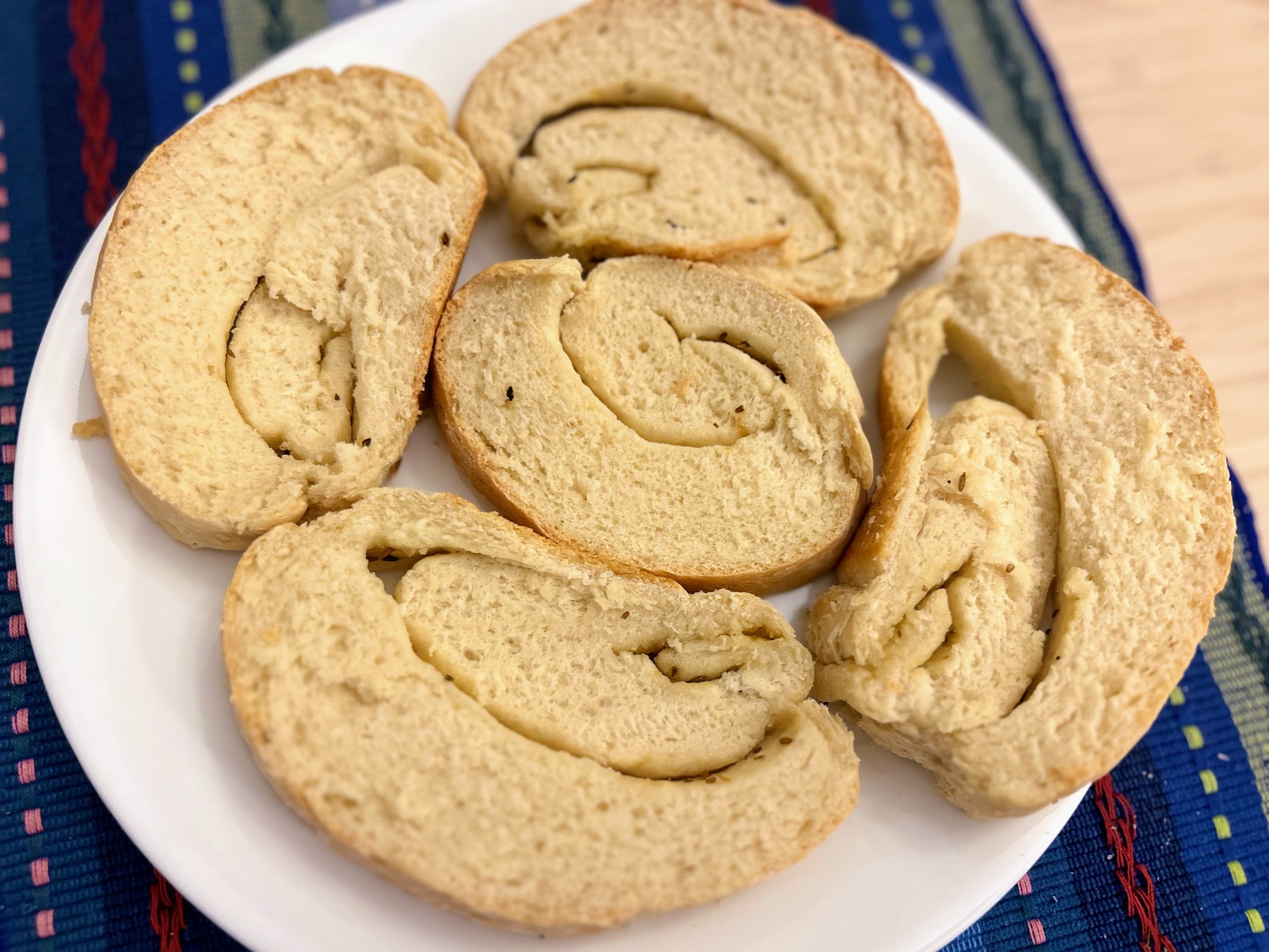
- Bake for 30 minutes, or until crust begins to turn golden-brown. Flip the bread over, then bake for another 10 minutes, until the other side has a golden crust. The Simply Tibetan blog describes the thick, golden crust as the best part of Amdo bread, and I wholeheartedly agree!
- Let bread cool before slicing, revealing the spiral-shaped interior.
Notes
In this recipe, the dough is rolled into cylinders, much like cinnamon rolls. Other recipes call for shaping the dough into rounds.
Share Recipe
Adapted from Simply Tibetan
Leave a Reply